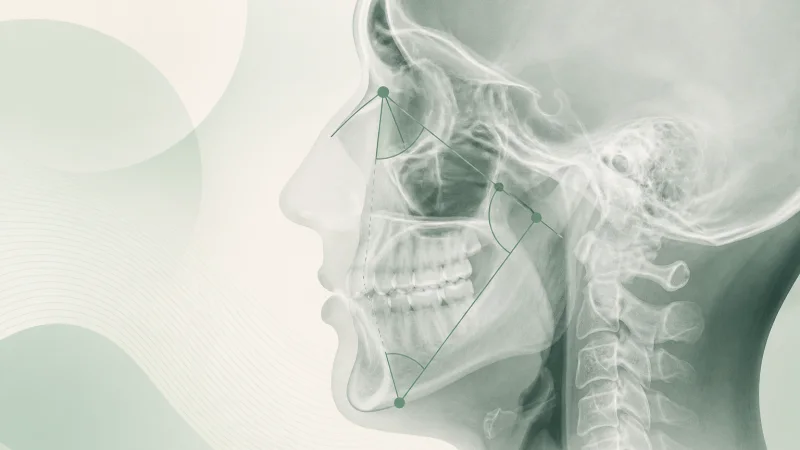
Kephalometrische Analysemethode

Steiner analysis online — lateral cephalogram analysis

Cecil C. Steiner · 1950er–1970er

Skelettklasse und Schneidezähne

Steiner analysis remains the starting point for lateral cephalometrics: SNA, SNB, and ANB define skeletal class, and the I-SN and i-MP block shows incisor compensation. CephCalc builds the table as soon as you mark S, N, A, B, and incisor axes on the lateral cephalogram. In residency it works well as a framework you can extend later with Wits or McNamara without re-uploading the film. Population norms for the patient profile appear in the table next to the angles.

5 kostenlose Patienten-Guthaben · kein Abo

Steiner

Über die Methode

Die klassische Steiner-Analyse bewertet die Lage von Ober- und Unterkiefer zur Schädelbasis und die Neigung der Schneidezähne zur SN-Ebene. Cecil C. Steiner prägte mit SNA, SNB und ANB die Sprache für Skelettklasse II und III auf dem Fernröntgenseitenbild. Die Schule verknüpft Kieferwinkel mit der Kompensation der Schneidezahnreihe bei typischen kieferorthopädischen Fehlstellungen. Am Behandlungsstuhl erhalten Sie einen sagittal–inzisalen Ausschnitt ohne Tabellenwechsel. In CephCalc kombiniert das Preset SN-Rahmen, I-SN, i-MP und den interinzisalen Winkel Ii auf einem Tracing.

Schwerpunkt der Analyse

Sagittale Kieferrelationen zu SN, Schneidezahnausrichtung zu SN und Gaumenebene, vertikaler Kontext SN-MP und SN-NL.

Klinischer Einsatz

Praktisch für die erste Einordnung von Skelettklasse und Schneidezahnneigung im Routinefall. Assistenzärzte beginnen die Auswertung der lateralen Fernröntgenaufnahme oft mit Steiner und verfeinern sagittal mit Wits oder linear mit McNamara. Bei grenzwertigem ANB genügt ein Winkel nicht — Profil und Okklusion klinisch mitdenken. Vor dem Multibracket-Bonding dokumentiert der Block I-SN und i-MP die Zieltorque im Protokoll. Bei Fallbesprechungen CephCalc-Tabelle mit Profilfotos, Modellen und Kiefergelenkbefund abgleichen: Zahlen ohne Kontext führen leicht in die Irre.

Was CephCalc berechnet

  • 14 Landmarks
  • 8 Messungen
  • SNA: ∠ SNA — Winkel zwischen S–N und A–N (Lage Oberkiefer relativ zur Schädelbasis)
  • SNB: ∠ SNB — Winkel zwischen S–N und B–N (Lage Unterkiefer)
  • ANB: ∠ ANB — Differenz der Kieferlagen: Winkel zwischen B–N und A–N
  • I-SN: ∠ I-SN — Neigung oberer Frontzähne A1–A2 zur S–N-Ebene
  • i-MP: ∠ i-MP — Neigung unterer Frontzähne B1–B2 zur K2–Me-Ebene
  • Ii: ∠ Ii — Interincisalwinkel zwischen Frontzahnachsen
  • SN-MP: ∠ SN-MP — Winkel zwischen S–N und Unterkiefer-Tangente K2–Me
  • SN-NL: ∠ SN-NL — Lage der Gaumenebene PNS–ANS relativ zu S–N

Key Steiner measurements for training

The S–N plane is the cranial base reference on the lateral cephalogram. SNA and SNB describe maxillary and mandibular position; ANB their relative shift. The incisor block shows how the dentition compensates for the skeleton. Students benefit from stating “angle, clinical meaning, possible mechanics” for each value. SN-MP and SN-NL give a first look at vertical relations but do not replace Jarabak.
  • SNA / SNB — jaw position to SN
  • ANB — guide to skeletal Class II/III
  • I-SN, i-MP — upper and lower incisor inclination
  • Ii — incisor balance between jaws
  • SN-MP, SN-NL — vertical background to sagittal angles

Landmarks and common tracing errors

Points S and N lie on the cranial base outline. A goes at the deepest point on the anterior maxillary apical base contour; B on the mandible by the same school rules. Moving A inferiorly lowers SNA; moving B forward raises SNB. Incisor axes follow the long axis of the crown, not the root on a blurred film. With head tilt, check SN symmetry.
  • S, N, A, B — basic framework; all angles depend on them
  • Check SN symmetry when the head is tilted
  • I and i — incisor axes, not crown edges
  • On repeat films, use the same landmark rules

Combining methods and limitations

Steiner does not measure jaw length or project A and B onto occlusion, so with mandibular retrognathia and a “normal” ANB add Wits. Growth type is better read with Jarabak or Björk. Steiner does not describe soft tissues or airway: for profile and pharynx use separate presets on the same film in CephCalc.
  • Wits — when ANB is borderline
  • McNamara — maxillary and mandibular lengths
  • Jarabak / Björk — growth type
  • Holdaway — lips and E-line
  • Steiner does not replace CBCT or polysomnography

In der Praxis ausprobieren — kostenlos

In der Praxis ausprobieren

Laden Sie eine Fernröntgen-Seitenaufnahme in CephCalc hoch, setzen Sie die Landmarks und starten Sie die Steiner-Analyse online — ohne Softwareinstallation. Kostenlos starten.

  • Fertiges Methoden-Preset auf Ihrem Röntgenbild
  • Tabelle mit Winkel- und Streckenmessungen und populationsbezogenen Referenznormen (kaukasisch, ostasiatisch, afrikanisch)
  • Speichern in der Patientenakte und PDF-Export
  • 5 kostenlose Patienten-Guthaben zum Einstieg

Häufige Fragen

How do I run Steiner analysis online?
Register in CephCalc, upload a lateral cephalogram, select the Steiner preset, and place landmarks S, N, A, B, and incisor axes. The SNA, SNB, ANB, and incisor block table appears automatically, saves to the patient chart, and exports to PDF.
Which measurements does Steiner analysis calculate?
The Steiner preset calculates SNA, SNB, ANB, incisor inclinations I-SN and i-MP, interincisal angle Ii, and SN-MP and SN-NL. These values describe sagittal relations, incisors, and basic vertical context on one tracing.
How should a resident read ANB together with the incisors?
First assess SNA and SNB: which jaw lags relative to SN. Then review I-SN and i-MP: a common Class II compensation is proclined upper incisors with a moderate ANB. Record both blocks in the treatment plan instead of reducing the diagnosis to one number.
When choose Steiner rather than McNamara or Wits?
Steiner answers the primary skeletal–incisor question. McNamara adds linear jaw lengths; Wits refines sagittal relations when ANB is doubtful. On one film in CephCalc you can switch presets without re-tracing and compare tables in the record.
Is Steiner enough for extraction planning?
Extraction decisions usually need soft-tissue profile with Holdaway or Merrifield and sometimes Jarabak growth type. Steiner covers skeleton and incisors but does not replace lip assessment or vertical prognosis in a growing patient.