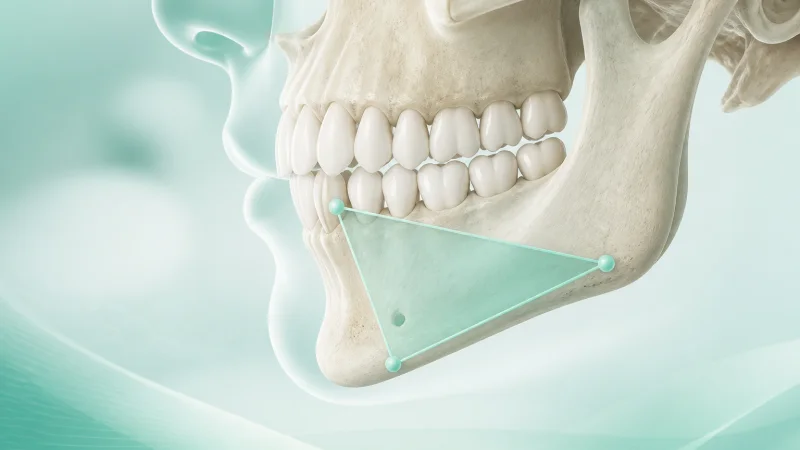
Tweed analysis centers planning on the mandibular plane Go–Me and lower incisor inclination i-MP. Charles H. Tweed linked SN, MP, and the lower incisor axis in a triangle that helps control torque. CephCalc calculates i-MP, SN-MP, and Ii on the same tracing as Steiner. Before bonding, this block is often required in residency records. Before bonding, compare i-MP with the vertical pattern from Jarabak.
Die Tweed-Schule baute die Planung um Unterkieferebene und Neigung der unteren Schneidezähne dazu. Charles H. Tweed verband SN, die Ebene Go–Me und die untere Schneideachse im Tweed-Dreieck, das die Torque-Kontrolle vor dem Apparat platziert unterstützt. i-MP und SN-MP beschreiben, wie der untere Bogen zur Gesichtsvertikalen steht. Der interinzisale Winkel Ii zeigt den Ausgleich der Neigungen zwischen den Kiefern. In CephCalc hebt das Preset i-MP, SN-MP und Ii als schnelle inzisal–vertikale Kontrolle am lateralen Fernröntgenbild hervor. i-MP im Protokoll so explizit dokumentieren wie das Ziel-ANB vor dem Bonding.
Schwerpunkt der Analyse
Ebene Go–Me, Neigung der unteren Schneidezähne i-MP, SN-MP, interinzisaler Winkel Ii.
Klinischer Einsatz
Praktisch bei Planung der unteren Schneidezahnlage und Beurteilung der Stabilität des unteren Bogens. Vor festsitzender Apparatur liest man Tweed oft mit Steiner für den skelettalen Hintergrund. Bei hyperdivergentem Muster i-MP mit Jarabak und S-Go/N-Me zusammen interpretieren. Tweed ersetzt Holdaway oder Merrifield für Lippen und Ästhetiklinie auf demselben Bild nicht. Bei Fallbesprechungen CephCalc-Tabelle mit Profilfotos, Modellen und Kiefergelenkbefund abgleichen: Zahlen ohne Kontext führen leicht in die Irre.
Was CephCalc berechnet
10 Landmarks
4 Messungen
SN-MP: ∠ SN-MP — Winkel zwischen S–N und Unterkiefer-Tangente K2–Me
i-MP: ∠ i-MP — Neigung unterer Frontzähne B1–B2 zur K2–Me-Ebene
Ii: ∠ Ii — Interincisalwinkel zwischen Frontzahnachsen
I-SN: ∠ I-SN — Neigung oberer Frontzähne A1–A2 zur S–N-Ebene
The Tweed triangle: measurements for training
The Tweed triangle links SN, MP, and the lower incisor axis. i-MP shows how far lower incisors incline to the mandibular plane. SN-MP describes MP inclination relative to SN. Ii reflects balance between jaws. Students benefit from drawing the triangle on the tracing before reading numbers in CephCalc.
i-MP — lower incisor axis to MP
SN-MP — vertical pattern
Ii — interincisal balance
I-SN — upper incisors when needed in the report
Go, Me landmarks and i-MP errors
Go and Me define MP: anterior Go placement raises SN-MP. The lower incisor axis follows the crown, not the root on a blurred film. With open bite on the ceph, i-MP may not match clinical occlusion. Note that in the record.
Go at the angle of body and ramus
Me and Pog — consistent with outline
ii — lower incisor for the axis
Repeatability on control cephalograms
Tweed combinations and limits
Tweed does not replace Jarabak when choosing elastics and controlling vertical. Wits refines sagittal relations if ANB misleads. Holdaway helps extraction decisions by profile. CephCalc combines presets on one tracing for sequential review.
Steiner — SNA, SNB, ANB
Jarabak — growth type
Holdaway — lips when changing i-MP
Wits — when class is uncertain
In der Praxis ausprobieren — kostenlos
In der Praxis ausprobieren
Laden Sie eine Fernröntgen-Seitenaufnahme in CephCalc hoch, setzen Sie die Landmarks und starten Sie die tweed-Analyse online — ohne Softwareinstallation. Kostenlos starten.
Fertiges Methoden-Preset auf Ihrem Röntgenbild
Tabelle mit Winkel- und Streckenmessungen und populationsbezogenen Referenznormen (kaukasisch, ostasiatisch, afrikanisch)
In CephCalc select the Tweed preset and mark Go, Me, S, N, and lower incisor axes. i-MP, SN-MP, and Ii appear in the table with norms and PDF export after saving to the patient chart.
What does Tweed analysis emphasize?
Tweed emphasizes the mandibular plane Go–Me, lower incisor inclination i-MP, SN-MP, and Ii. Steiner is stronger in SNA, SNB, and ANB. In practice they are read together before bonding.
How should a resident use i-MP before bonding?
Match i-MP to the planned lower incisor position. In a hyperdivergent pattern, be cautious with lower incisor distalization. Record i-MP and SN-MP in the chart before active mechanics start.
When is Tweed preferable to Steiner?
Tweed is preferable when the main question is lower incisor position and torque, not primary skeletal class. Steiner remains the start for ANB; Tweed refines the lower arch.
Does Tweed combine with soft-tissue analysis?
Yes. Holdaway and Merrifield describe lips; Tweed describes lower incisors to MP. On one film CephCalc switches presets without new tracing if soft-tissue points are already marked.
Wir nutzen technische Browserdaten für Betrieb, Authentifizierung und Analyse. Drittanbieter (einschließlich Yandex.Metrica) können ebenfalls Daten in Ihrem Browser speichern.