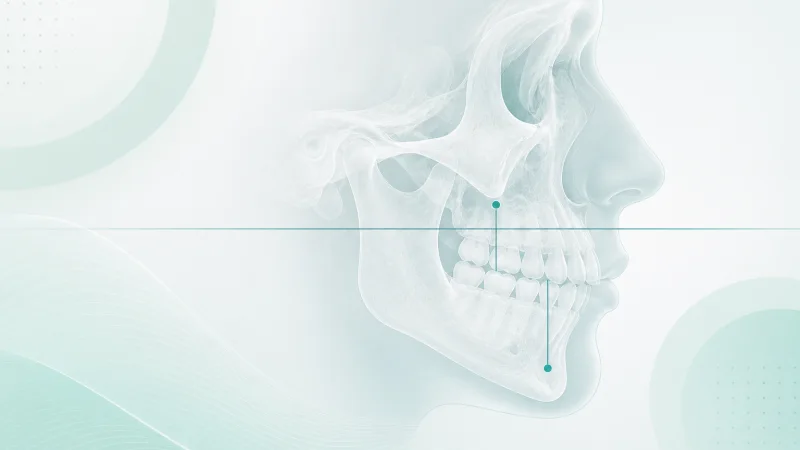
Wits appraisal refines sagittal apical base relations by projecting points A and B onto the occlusal plane. The value depends less on SN inclination than ANB, so it is used with jaw rotation and borderline classes. CephCalc calculates Wits with SNA, SNB, and ANB in one table after occlusal plane tracing. Read Wits next to ANB in borderline class.
Das Wits-Appraisal verfeinert die sagittale apikale Basisrelation durch Projektion der Punkte A und B auf die Okklusionsebene. A. Jacobson zeigte, dass das Maß weniger von der SN-Neigung abhängt als ANB. Daher nutzt man Wits bei Kieferrotation und grenzwertigen Klassen. Wits zusammen mit SNA, SNB und ANB lesen, nicht an deren Stelle. Der lineare Millimeterwert lässt sich leichter mit Profil und Camouflage-Planung verbinden. In CephCalc steht Wits nach dem Tracing von A, B und Okklusionsebene in einer Tabelle mit Steiner. In der Beratung hilft ein PDF mit Wits und ANB, wenn Profil und Winkel auseinanderlaufen.
Schwerpunkt der Analyse
Wits in Millimetern, Projektion von A und B auf die Okklusionsebene, Winkel SNA, SNB, ANB als Kontext.
Klinischer Einsatz
Nützlich bei zweifelhaftem ANB, Kieferrotation und wenn das klinische Profil nicht zu den Sagittalwinkeln passt. Vor Camouflage versus Operation liest man Wits oft nach Steiner oder Hasund. Assistenzärzte sollten das Vorzeichen von Wits mit dem Befund abgleichen, nicht isoliert. Die Qualität hängt von der Okklusionsebene durch Zahnkontakte auf der Aufnahme ab. Bei Fallbesprechungen CephCalc-Tabelle mit Profilfotos, Modellen und Kiefergelenkbefund abgleichen: Zahlen ohne Kontext führen leicht in die Irre. Wits im Protokoll neben ANB dokumentieren.
Was CephCalc berechnet
6 Landmarks
4 Messungen
Wits: Wits (mm) — Abstand der Projektionen von A und B auf die Okklusionsebene ii–P6
ANB: ∠ ANB — Differenz der Kieferlagen: Winkel zwischen B–N und A–N
SNA: ∠ SNA — Winkel zwischen S–N und A–N (Lage Oberkiefer relativ zur Schädelbasis)
SNB: ∠ SNB — Winkel zwischen S–N und B–N (Lage Unterkiefer)
Wits and ANB: what to practice
Jacobson proposed Wits as a linear sagittal measure complementing ANB. Projecting A and B onto the occlusal plane turns an angular problem into millimeters useful in camouflage planning. SNA and SNB stay for context. Students benefit from drawing projections on the tracing before automatic calculation in CephCalc.
Wits — mm on OP
ANB — degrees between NA and NB
SNA, SNB — context
Compare with clinical class
A, B, and occlusion: typical errors
The occlusal plane follows incisor and molar contacts when visible. With open mouth on the film Wits is unreliable. Points A and B follow Steiner rules. Occlusal plane repeatability between visits matters for serial data.
A, B — standard subsellar/subsymphyseal points
ii–P6 consistent with occlusion
Do not mix Wits from different OP definitions
Serial films: same OP on control cephs
Wits combinations and limits
Wits does not describe growth type: add Jarabak or Björk. McNamara gives jaw lengths. Holdaway addresses lips. CephCalc switches presets without re-uploading the cephalogram.
Steiner — primary framework
McNamara — jaw lengths
Hasund — Wits + vertical + incisors
CBCT — asymmetry and TMJ
In der Praxis ausprobieren — kostenlos
In der Praxis ausprobieren
Laden Sie eine Fernröntgen-Seitenaufnahme in CephCalc hoch, setzen Sie die Landmarks und starten Sie die Wits-Analyse online — ohne Softwareinstallation. Kostenlos starten.
Fertiges Methoden-Preset auf Ihrem Röntgenbild
Tabelle mit Winkel- und Streckenmessungen und populationsbezogenen Referenznormen (kaukasisch, ostasiatisch, afrikanisch)
In CephCalc select the Wits preset, mark A, B, S, N, and the occlusal plane. Wits in millimeters appears with SNA, SNB, and ANB in the report with race-specific norms.
Why use Wits when ANB is available?
ANB depends on SN inclination and jaw rotation. Wits projects A and B onto the occlusal plane and often agrees better with profile in borderline cases. Read both together.
How should a student interpret Wits sign?
Positive Wits often associates with more marked Class II by bases, negative with Class III, but always cross-check sign with clinical profile and occlusion. Record Wits next to ANB in the chart.
When is Wits especially useful?
Wits helps with doubtful ANB, distal or mesial jaw position, and when angles disagree with appearance. Before camouflage or surgery Wits often follows Steiner.
Does Wits depend on the occlusal plane?
Yes. Wits is defined by the occlusal plane through tooth contacts on the film. Plane error shifts A and B projections. Note occlusal quality on the ceph in the record.
Wir nutzen technische Browserdaten für Betrieb, Authentifizierung und Analyse. Drittanbieter (einschließlich Yandex.Metrica) können ebenfalls Daten in Ihrem Browser speichern.