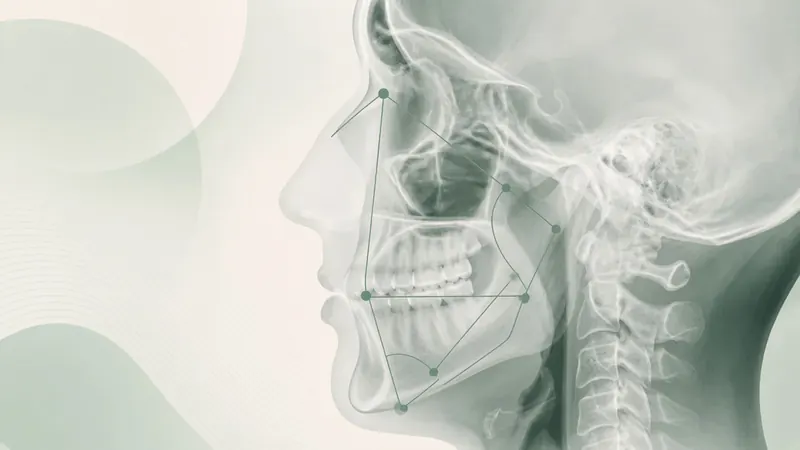
For borderline Class III in adults: orthodontic camouflage or referral to jaw surgery. Wits, ANB, i-MP, and Beta in one CephCalc report. Try it in practice — free start for orthodontists.
5 free patient credits · try it in practice · no subscription
About the scenario
In adults with Class III the key question is whether skeletal disharmony can be compensated orthodontically or needs orthognathic preparation. Wits below −5.8 mm in the scenario marks a zone of marked Class III or surgical discussion as a literature reference, not an absolute cutoff. Wits from −5.8 to 0 mm describes a border where camouflage is sometimes possible if incisor compensation reserve is adequate. ANB and Beta add context when jaws are rotated. The scenario does not label “surgery” — it structures the conversation with the patient. CephCalc shows all measures together so you do not rely on a single negative ANB. In adults, growth will not fix the skeleton, so camouflage realism is judged up front.
When to use it
When ANB < 0 or Wits < 0 in an adult and you need to discuss scale before fixing the plan. Combine with “Dentoalveolar compensation in Class III” if incisors already mask the skeleton. Consider profile, aesthetics, and function clinically: Holdaway H-angle and E-line are not calculated in v1. With marked asymmetry, add exam and other imaging as needed.
Holdaway H-angle is not calculated — assess profile clinically.
There is no single Wits threshold in the literature; −5.8 mm is a research reference.
How to read Wits and compensation
Wits sets sagittal problem scale in millimeters; ANB checks the angular picture. i-MP shows whether lower incisor retraction is already spent. If Wits is deeply negative and i-MP is already low, camouflage hits a biologic limit quickly.
Wits — start for Class III grading
ANB confirms direction; it does not duplicate Wits
Assess i-MP before promising retraction
Beta helps when bases are rotated
Cross-check with “Compensation in Class III” on the same image
Scenario limitations
Cephalometry does not replace maxillofacial consultation, facial analysis, or articulator mounting. Soft tissues and psychosocial expectations are not in the calculation. The scenario does not define osteotomy volume or replace CBCT when joint pathology is suspected. One literature Wits threshold does not override clinical judgment.
Assess E-line and H-angle on photos
Asymmetry is poorly seen on one lateral cephalogram
Surgical planning needs in-person exam
Dentoalveolar masking appears only in combined measures
The scenario does not predict stability after camouflage
Try it in practice — free
Try it in practice
Upload a lateral cephalogram to CephCalc, select the “Class III: camouflage vs surgery” scenario, and get a structured report with key measurements — no software to install. Try it free.
The scenario uses Wits < −5.8 mm as a surgical or marked Class III zone. Literature has no single threshold. CephCalc shows the value and interpretation; final decision depends on profile and patient expectations.
Is lip profile included?
No. E-line and Holdaway H-angle are not in v1 calculations. Assess soft tissues clinically and on profile photos in addition to cephalometry.
How does this relate to “Compensation in Class III”?
“Camouflage vs surgery” addresses problem scale. “Dentoalveolar compensation in Class III” shows existing incisor inclination and whether reserve is exhausted. Use both on the same image in CephCalc.
How can I practice borderline Class III?
Take three radiographs with slightly, moderately, and deeply negative Wits. For each write ANB, Wits, and i-MP and state what camouflage volume is biologically plausible. Comparing with the interpretation teaches you not to confuse “mild III” with an already compensated skeleton.
Can orthodontics start before a surgery decision?
Sometimes a preparatory phase runs, but in an adult with marked Class III it helps to define the camouflage limit early. The scenario anchors the starting point on cephalometry for discussion with the patient and surgeon.
We use technical browser data for site operation, authentication, and analytics. Third-party services (including Yandex.Metrica) may also store data in your browser.