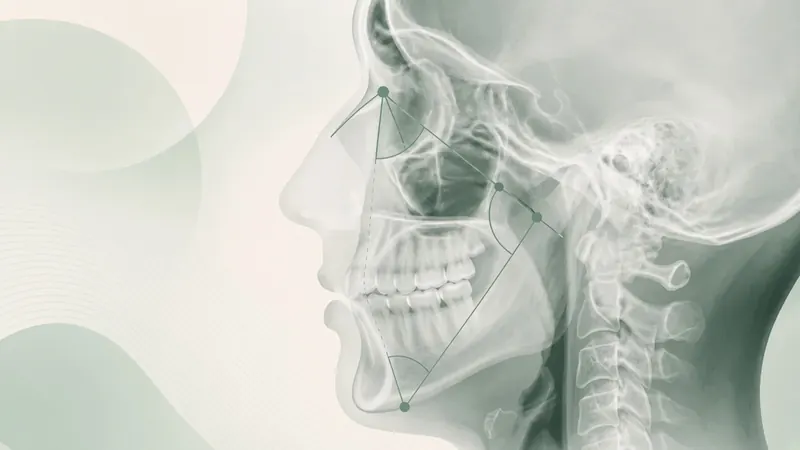
For low SN-MP and upright incisors — the typical deep bite and Class II division 2 pattern. CephCalc helps choose a conservative non-extraction plan. Try it in practice on your lateral cephalogram — free start.
5 free patient credits · try it in practice · no subscription
About the scenario
Horizontal growth type (SN-MP below norm) with vertically oriented upper incisors (I-SN below typical II/1 values) fits Class II division 2 and deep bite. In adults, extraction in this combination often worsens profile, and classic retraction can deepen the bite. The scenario emphasizes SN-MP, I-SN, I-NL, and Ii in one CephCalc interpretation. It answers how strongly the pattern argues against extraction and for intrusion with vertical control — not general skeletal class. Activation when SN-MP < 32° highlights hypodivergence as the key risk. Match with clinical overbite depth because cephalometry does not measure overbite in millimeters.
When to use it
When II/2 or marked deep bite is suspected in an adult with low SN-MP. Logical after “Vertical facial pattern” when hypodivergence is already visible. Confirm deep bite, molar class, and incisor position clinically — they are not auto-calculated. When extraction is debated, compare with “Extraction in Class II/1,” which uses different vertical logic.
Clinical deep bite and molar class are not considered.
How to read deep-bite pattern on cephalometry
Low SN-MP sets vertical risk; I-SN and I-NL describe upper incisor inclination; Ii shows arch coordination. If I-SN is already low, extra retraction rarely helps bite depth. Residents benefit from separating this set from II/1 with high SN-MP before choosing a premolar scheme.
SN-MP < 32° — scenario trigger
Low I-SN is typical for II/2
Ii helps distinguish mixed patterns
I-NL refines upper incisor position
Cross-check with clinical overbite
Limitations and errors
The scenario does not replace TMJ assessment, models, or photos. It does not plan specific intrusion mechanics or show wear facets. Extraction “by habit” in Class II without SN-MP is a common mistake here. Soft tissues and treatment duration stay in the clinical plan.
Overbite in mm — from models
Extraction does not treat bite depth by itself
Hypodivergence increases opening risk with wrong mechanics
Does not replace “Skeletal class”
Function and bruxism — clinical assessment
Try it in practice — free
Try it in practice
Upload a lateral cephalogram to CephCalc, select the “Deep bite / Class II, division 2” scenario, and get a structured report with key measurements — no software to install. Try it free.
Why does the scenario not recommend extraction for deep bite?
With low SN-MP and upright incisors, premolar removal often worsens profile and does not resolve bite depth. CephCalc shows this combination and suggests a conservative approach with vertical control.
Which measurements are key?
SN-MP (vertical type), I-SN and I-NL (upper incisor inclination and position), Ii (interincisal angle). All appear in the table after Steiner and Downs landmarking.
How is this different from “Vertical facial pattern”?
“Vertical facial pattern” describes the general pattern. This scenario focuses on hypodivergence combined with incisor position — typical for II/2 and deep bite.
How can I tell II/2 from II/1 on cephalometry?
Compare one radiograph with low SN-MP and low I-SN against one with high SN-MP and raised I-SN. Note which extraction scheme seems plausible before the interpretation. That reinforces the vertical–subclass link.
When does the scenario not activate?
If SN-MP is not below the scenario threshold, II/2 with deep bite may be less obvious on cephalometry. Then rely on the clinic and “Vertical facial pattern” rather than forcing the scenario conclusion.
We use technical browser data for site operation, authentication, and analytics. Third-party services (including Yandex.Metrica) may also store data in your browser.