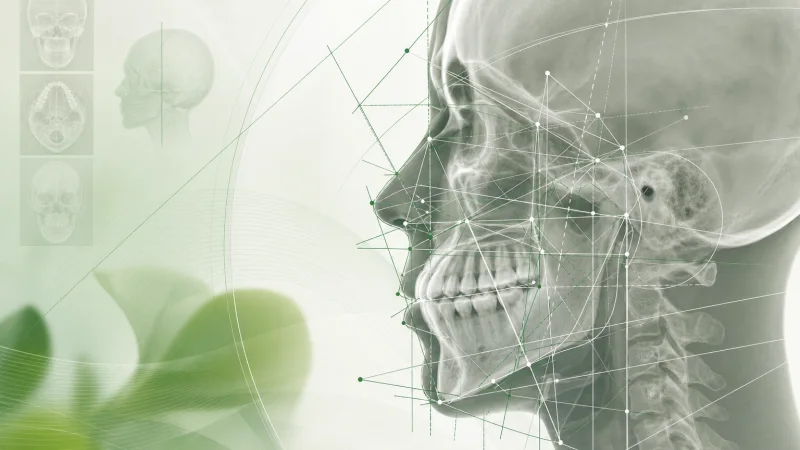
Ricketts analysis delivers an extended skeletal, vertical, and dentoalveolar profile on one lateral cephalogram. Robert M. Ricketts combined sagittal relations, growth, Wits, and soft-tissue angles in one report logic. CephCalc implements a practical core set; the full 33-factor Ricketts remains in development. Complex cases with doubtful ANB and lip esthetics often start with this preset. The wide report helps when a short school is not enough.
5 free patient chart slots · try it in practice · no subscription
About the method
Ricketts proposed an expanded skeletal, vertical, and dentoalveolar profile on one lateral cephalogram. Robert M. Ricketts combined sagittal, growth measures, Wits, and a soft-tissue block in one report logic. The practical CephCalc preset reflects core indices: the full 33-factor Ricketts set remains on the product roadmap. H-angle and Z-angle give a first look at lip profile without changing landmarks. The preset shows how cephalometric blocks fit one table.
What the analysis focuses on
Skeletal angles SNA, SNB, ANB and Wits, vertical SN-MP and S-Go/N-Me, incisors I-NL and i-MP, soft tissues H-angle and Z-angle.
When to use it clinically
Convenient when a short school is not enough and you need growth, vertical, and profile on one image. Fits complex cases with doubtful ANB and simultaneous lip esthetic questions. Helps students connect angles to clinical meaning in one PDF. For a narrow airway question add McNamara airways — do not expect full sleep screening from Ricketts. On case review, match the CephCalc table with profile photos, models, and TMJ exam: numbers without context are easy to misread.
What CephCalc calculates
22 landmarks
17 measurements
SNA: ∠ SNA — angle between lines S–N and A–N (maxillary position relative to the cranial base)
SNB: ∠ SNB — angle between lines S–N and B–N (mandibular position)
ANB: ∠ ANB — difference in jaw positions: angle between B–N and A–N
SN-MP: ∠ SN-MP — angle between S–N and the mandibular tangent K2–Me
SN-NL: ∠ SN-NL — orientation of the palatal plane PNS–ANS relative to S–N
NL-MP: ∠ NL-MP — angle between the palatal plane and K2–Me
Ii: ∠ Ii — interincisal angle between incisor axes
I-NL: ∠ I-NL — upper incisor inclination to the palatal plane
i-MP: ∠ i-MP — lower incisor inclination B1–B2 to the K2–Me plane
I-SN: ∠ I-SN — upper incisor inclination A1–A2 to the S–N plane
Go: ∠ Go — mandibular angle between K1–Co and K2–Me
S-Go/N-Me: S-Go/N-Me (%) — ratio of posterior to anterior face height
Wits: Wits (mm) — distance between projections of A and B onto the occlusal plane ii–P6
H-angle: ∠ H-angle (Holdaway) — angle at N between lines N–PogSoft and N–Pn
E-Ls: E-Ls (mm) — distance from Ls to the esthetic line Pn–PogSoft (+ lip anterior to line)
E-Li: E-Li (mm) — distance from Li to the esthetic line Pn–PogSoft (+ lip anterior to line)
Z-angle: ∠ Z-angle (Merrifield) — angle between the S–N plane and line PogSoft–Li (FH substitute)
Ricketts measurement blocks for residents
Ricketts teaches reading sagittal relations with Wits and vertical SN-MP together. S-Go/N-Me links growth to facial type. The incisor block I-NL and i-MP shows compensation. H-angle and Z-angle give a first soft-tissue layer without Holdaway. Residents benefit from printing the PDF and color-labeling blocks for supervisor review.
SNA, SNB, ANB, Wits — sagittal
SN-MP, S-Go/N-Me — vertical
I-NL, i-MP, Ii — incisors
H-angle, Z-angle — soft tissue
Tracing: skeleton plus soft tissue
Soft-tissue points depend on film contrast: mark PogSoft and lips on contour, not by guess. Wits depends on the occlusal plane. With blurred Go, interpret SN-MP cautiously. Tracing repeatability matters more than chasing “perfect” millimeters.
Pn, Ls, Li, PogSoft — profile
Skeleton first, then soft tissue
Do not duplicate skeletal Pog and PogSoft
Film quality is critical for lips
Combinations and limitations
Ricketts does not replace McNamara airways for snoring. Björk and Jarabak go deeper on growth type with Articulare and S-Go/N-Me. Holdaway is more precise for E-line in extraction decisions. CephCalc lets you add narrow presets after broad Ricketts on the same film.
Jarabak / Björk — deeper growth analysis
McNamara airways — pharynx
Slavicek — OP–FH
33-factor — not fully in the product
Try it in practice — free
Try it in practice
Upload a lateral cephalogram to CephCalc, place the landmarks, and run the Ricketts analysis online — no software to install. Try it in practice free.
Ready-made method preset on your radiograph
Table of angular and linear measurements with race-specific reference norms (Caucasoid, East Asian, African)
Register in CephCalc, upload a lateral cephalogram, select the Ricketts preset, and mark skeletal, incisor, and soft-tissue landmarks. The key measurement table appears with race-specific norms.
Is the full 33-factor Ricketts available yet?
The full 33-factor Ricketts is not yet in the CephCalc core. Key sagittal, vertical, Wits, incisor, and basic soft-tissue H-angle and Z-angle values are available from the current tracing.
How can a student avoid drowning in a wide report?
Split the report into blocks: sagittal SNA, SNB, ANB, and Wits, then vertical SN-MP and S-Go/N-Me, then incisors and soft tissue. Write one clinical conclusion per block instead of interpreting every row on the first review.
Who is the extended Ricketts profile for?
Ricketts suits cases when a short school is not enough and you need a coherent picture of growth, vertical relations, and profile on one film. Especially Class II with incisor compensation and lip questions.
How does Ricketts differ from Tübingen?
Ricketts is broader in soft tissue; Tübingen adds linear jaw lengths and university-style block grouping. Both can be compared in CephCalc by switching preset without new tracing.
We use technical browser data for site operation, authentication, and analytics. Third-party services (including Yandex.Metrica) may also store data in your browser.