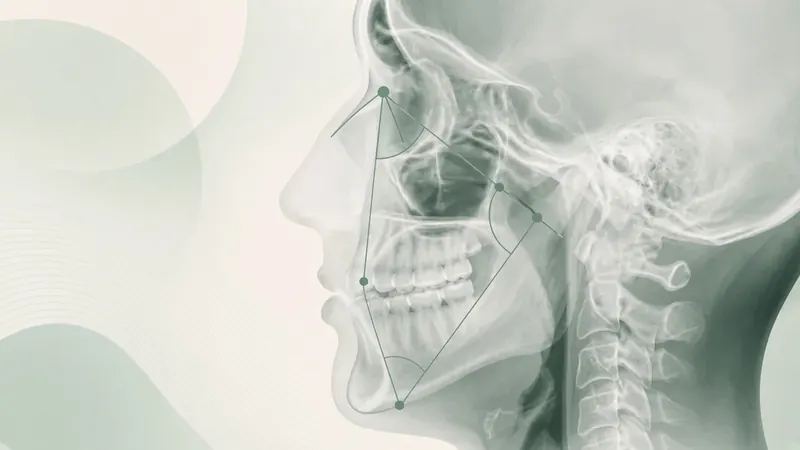
Assess existing dentoalveolar compensation in skeletal Class III and whether incisor movement reserve is exhausted. i-MP, I-SN, ANB, and Wits in a structured CephCalc report. Try it in practice — free start.
5 free patient credits · try it in practice · no subscription
About the scenario
In skeletal Class III, incisors often compensate: upper protrusion, lower retrusion, or both. The occlusion may look milder clinically than on cephalometry while incisor movement reserve is used up. Extreme i-MP and I-SN signal decompensation risk if you plan camouflage. The scenario links the incisor block with ANB and Wits in one CephCalc report for adults. It answers how much compensation is already spent — not whether surgery is needed (that is “Camouflage vs surgery”). Without accounting for compensation, orthodontic possibilities are easy to overestimate.
When to use it
When ANB < 0 or Wits < 0 and you consider orthodontic Class III camouflage in an adult. Open after “Skeletal class” and together with “Camouflage vs surgery.” Does not replace occlusion, models, or function assessment. With marked lower incisor retrusion, discuss retraction limits with the patient early.
Compare I-SN and i-MP with norms: upper protrusion with low i-MP often means lowers are already “given back.” Wits shows the skeletal backdrop for that mask. Residents benefit from sketching skeleton versus incisors before reading the interpretation.
High I-SN in Class III — typical upper compensation
Low i-MP limits further retraction
ANB/Wits fix the skeleton under compensation
Look at both arches, not only lower incisors
Cross-check with clinical overjet
What the scenario does not do
It does not predict post-treatment stability or assess periodontal support for incisors. Soft tissues and speech are not calculated. It does not replace jaw localization and does not show transverse discrepancy.
Models are needed for arch direction and occlusal contacts
Profile photos show lip effect of compensation
Decompensation during treatment changes profile and function
One i-MP does not cancel a deeply negative Wits
CBCT does not automatically substitute for the lateral cephalogram
Try it in practice — free
Try it in practice
Upload a lateral cephalogram to CephCalc, select the “Dentoalveolar compensation in Class III” scenario, and get a structured report with key measurements — no software to install. Try it free.
Incisor inclination that partially hides skeletal Class III: upper protrusion (I-SN above norm) or lower retrusion (i-MP below norm). CephCalc shows both blocks alongside ANB and Wits.
When does compensation limit treatment?
If lower incisors are already retruded (low i-MP), further retraction may be impossible. If uppers are maximally proclined, protrusion reserve is spent. The scenario flags the tendency in the report.
When does the scenario activate?
When ANB < 0 or Wits < 0 — confirmed or likely skeletal Class III. Run “Skeletal class” first, then move to compensation on the same image.
How can I learn to see Class III masked by incisors?
Compare molar class clinically with ANB/Wits on one patient. Write I-SN and i-MP and describe which incisor hides the skeleton. Repeat on a second radiograph without reading the interpretation first.
Do I need this scenario for mild Class III without compensation?
Yes, if Wits is negative: absence of compensation matters too — it means more incisor movement but greater profile risk. Combine with “Camouflage vs surgery.”
We use technical browser data for site operation, authentication, and analytics. Third-party services (including Yandex.Metrica) may also store data in your browser.