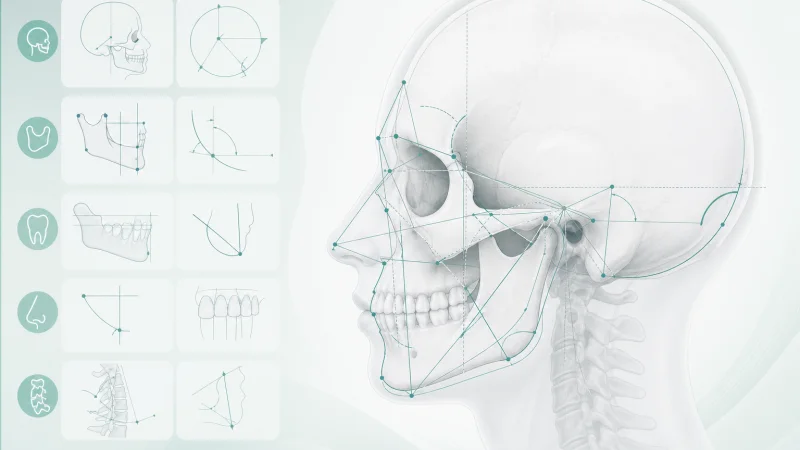
Hasund (Bergen) analysis combines skeletal, vertical, and dentoalveolar measurements in one lateral cephalogram report. The Bergen school groups sagittal relations, vertical, incisors, and Wits in one logic. CephCalc implements the core landmark set. The preset sits between narrow Steiner and wide Tübingen. A mid-width preset between Steiner and Tübingen.
5 free patient chart slots · try it in practice · no subscription
About the method
Bergen / Hasund combines skeletal, vertical, and dentoalveolar measures in a linked report system. The Bergen school builds cephalometry so sagittal, vertical, incisors, and Wits appear in one protocol logic. The CephCalc core set covers key angles and linear values from available landmarks. Individualized Bergen norms remain on the product roadmap. The preset fits when you want a “middle” broad profile between Steiner and Tübingen. Check source image quality: soft-tissue contrast and landmark clarity affect CephCalc table repeatability on serial cephalograms. Bergen report is convenient when you need Wits without a separate Jacobson preset.
What the analysis focuses on
SNA, SNB, ANB, Wits, vertical SN-MP and NL-MP, incisors I-SN, I-NL, i-MP, Ii.
When to use it clinically
Convenient for a structured lateral cephalogram report in moderately complex cases without switching several short presets. Fits primary review when one table should cover sagittal, vertical, and incisors at once. Always supplement with clinical exam and photos. For narrow airway or deep gnathology add specialized presets. On case review, match the CephCalc table with profile photos, models, and TMJ exam: numbers without context are easy to misread.
What CephCalc calculates
18 landmarks
12 measurements
SNA: ∠ SNA — angle between lines S–N and A–N (maxillary position relative to the cranial base)
SNB: ∠ SNB — angle between lines S–N and B–N (mandibular position)
ANB: ∠ ANB — difference in jaw positions: angle between B–N and A–N
Wits: Wits (mm) — distance between projections of A and B onto the occlusal plane ii–P6
SN-MP: ∠ SN-MP — angle between S–N and the mandibular tangent K2–Me
SN-NL: ∠ SN-NL — orientation of the palatal plane PNS–ANS relative to S–N
NL-MP: ∠ NL-MP — angle between the palatal plane and K2–Me
I-SN: ∠ I-SN — upper incisor inclination A1–A2 to the S–N plane
I-NL: ∠ I-NL — upper incisor inclination to the palatal plane
i-MP: ∠ i-MP — lower incisor inclination B1–B2 to the K2–Me plane
Ii: ∠ Ii — interincisal angle between incisor axes
Go: ∠ Go — mandibular angle between K1–Co and K2–Me
Bergen blocks for students
Bergen links Wits with SNA, SNB, and ANB in one table. Vertical NL-MP complements SN-MP. The incisor block shows compensation on the skeleton. Students benefit from comparing Hasund with Steiner on one film to see added rows.
SNA, SNB, ANB, Wits
SN-MP, NL-MP, Go
I-SN, I-NL, i-MP, Ii
Check race-specific norms
Tracing Wits inside Hasund
Wits accuracy depends on the occlusal plane. NL needs correct ANS and PNS. With open mouth on the ceph some incisor angles are unreliable. Note film quality in the record.
A, B — stable between visits
ii–P6 — representative OP
NL through ANS–PNS
Go–Me — MP
Combinations and limitations
Hasund does not replace McNamara airways. Holdaway covers lips. Björk and Jarabak go deeper on growth. CephCalc keeps one tracing when switching from Bergen to narrow Wits.
Jarabak — growth type
McNamara airways — pharynx
Tübingen — wider still
Holdaway — profile
Try it in practice — free
Try it in practice
Upload a lateral cephalogram to CephCalc, place the landmarks, and run the Bergen / Hasund analysis online — no software to install. Try it in practice free.
Ready-made method preset on your radiograph
Table of angular and linear measurements with race-specific reference norms (Caucasoid, East Asian, African)
Register in CephCalc, upload a lateral cephalogram, select Hasund, and trace Bergen landmarks. SNA, SNB, ANB, Wits, vertical, and incisor tables export to PDF.
Are individualized Hasund norms available yet?
Bergen/Hasund individualized norms are live: ANB, SNA, and SNB bands shift with SN-MP (facial type). Population packs and age/sex layers for Co-Go / Co-Me also apply.
How should a resident walk through Hasund at review?
Go block by block: sagittal, Wits, vertical SN-MP and NL-MP, then I-SN, I-NL, i-MP, and Ii. One conclusion per block avoids overloading residency review.
Who is Bergen / Hasund for?
Hasund suits a structured report of medium width when you need more than Steiner but not the full Tübingen set. Good for a clinic primary protocol.
Hasund versus Tübingen?
Hasund is more compact in grouping; Tübingen adds more linear lengths and university emphases. Both switch in CephCalc on one tracing.
We use technical browser data for site operation, authentication, and analytics. Third-party services (including Yandex.Metrica) may also store data in your browser.