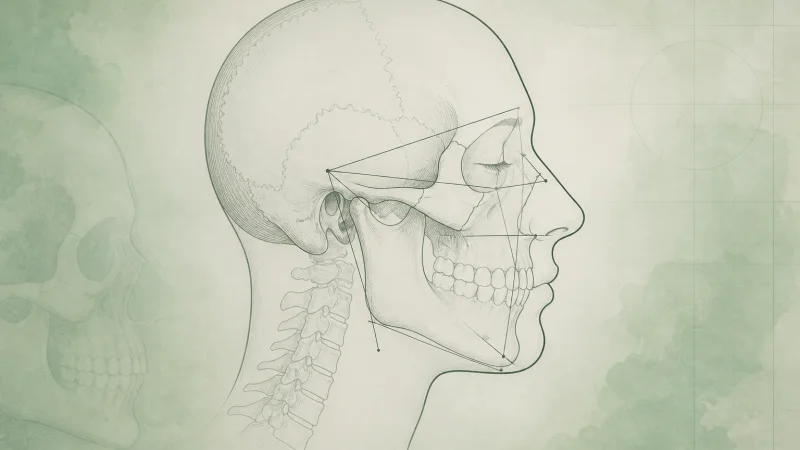
Downs analysis keeps the historical framework of the lateral cephalogram: William B. Downs systematized SNA, SNB, ANB, and incisor relations to SN and the mandibular plane in the mid-20th century. In CephCalc the preset is useful for teaching comparison with Steiner and Schwarz on one tracing. Residents see how classic angles agree or diverge between schools in one PDF report. It works as a department reference for classic angles.
5 free patient chart slots · try it in practice · no subscription
About the method
Downs analysis is one of the early systematic approaches to the lateral cephalogram, and many later schools grew from it. William B. Downs described sagittal profile through SNA, SNB, and ANB and linked it to incisor inclination to SN and the mandibular plane. The set keeps a historical framework for teaching comparison with Steiner, Schwarz, and Schmüth on one tracing. SN-MP and interincisal angle Ii add vertical and incisor balance to sagittal. In CephCalc the preset delivers a classic sagittal–incisor report without table overload.
What the analysis focuses on
Sagittal angles SNA, SNB, ANB, SN-MP, incisor inclination i-MP and I-SN, interincisal angle Ii.
When to use it clinically
Suitable for comparison with historical norms and demonstrating classic angles to residents. At the chair Downs works as a reference sagittal–incisor slice next to Steiner or Schwarz. It does not replace growth-type assessment — use Jarabak or Björk for vertical. For treatment planning add Wits when ANB is doubtful and Holdaway when extraction is debated on profile grounds. On case review, match the CephCalc table with profile photos, models, and TMJ exam: numbers without context are easy to misread.
What CephCalc calculates
12 landmarks
7 measurements
SNA: ∠ SNA — angle between lines S–N and A–N (maxillary position relative to the cranial base)
SNB: ∠ SNB — angle between lines S–N and B–N (mandibular position)
ANB: ∠ ANB — difference in jaw positions: angle between B–N and A–N
SN-MP: ∠ SN-MP — angle between S–N and the mandibular tangent K2–Me
Ii: ∠ Ii — interincisal angle between incisor axes
i-MP: ∠ i-MP — lower incisor inclination B1–B2 to the K2–Me plane
I-SN: ∠ I-SN — upper incisor inclination A1–A2 to the S–N plane
Downs measurements for students
Downs introduced the familiar SNA, SNB, ANB trio and showed how incisors compensate for the skeleton. SN-MP gives a first look at mandibular vertical inclination. Ii links upper and lower incisor inclinations. On case review, record the angles and one clinical hypothesis they support. Comparison with Schwarz teaches reading NL–MP alongside ANB.
SNA, SNB, ANB — skeletal class
I-SN, i-MP — incisor compensation
Ii — interincisal balance
SN-MP — mandibular plane inclination
Tracing and typical errors
Baseline points S, N, A, and B define all Downs angles. Check SN symmetry when the head is tilted on the film. Incisor axes follow the crown long axis. On repeat cephalograms use the same tracing rules or angle trends will be misleading. SN-MP is sensitive to Me and Go placement.
Check film quality before tracing
Go and Me on cortical outline
Incisor axes through crown centers
SN symmetry — marker for head tilt
Combinations and limitations
Downs does not measure Wits or jaw lengths: add Wits or McNamara in borderline class. Jarabak and Björk cover growth type. Holdaway and Merrifield address lips. CephCalc lets you switch presets on one tracing without paper re-tracing.
McNamara — jaw lengths
Wits — ANB refinement
Tweed — focus on i-MP
Schwarz — NL and MP in one report
Try it in practice — free
Try it in practice
Upload a lateral cephalogram to CephCalc, place the landmarks, and run the Downs analysis online — no software to install. Try it in practice free.
Ready-made method preset on your radiograph
Table of angular and linear measurements with race-specific reference norms (Caucasoid, East Asian, African)
Register in CephCalc, upload a lateral cephalogram, select the Downs preset, and trace landmarks. Sagittal angles and the incisor block appear in the table with race-specific norms and save to the patient chart.
Which measurements are in the Downs preset?
SNA, SNB, ANB, SN-MP, interincisal angle Ii, and i-MP and I-SN inclinations are in the Downs preset. The set is close to Steiner; schools differ in emphasis and report layout. Both presets can be compared on one film without re-tracing.
Why use Downs if Steiner exists?
For historical cross-checks and exam review: many texts cite Downs as the source of the angular scheme. Clinically both schools give similar numbers with the same S, N, A, and B tracing.
Can I compare Downs and Steiner on the same film?
Switch preset in CephCalc without re-tracing and compare Steiner and Downs tables in the PDF for the record. That speeds teaching review and shows angle stability when the school changes.
What should I add to Downs for treatment planning?
Add Jarabak for growth type, Wits when ANB is doubtful, and Holdaway when extraction depends on profile. Downs alone does not describe lips or airway on the lateral cephalogram.
We use technical browser data for site operation, authentication, and analytics. Third-party services (including Yandex.Metrica) may also store data in your browser.